Last Updated on September 10, 2026 by Gavi
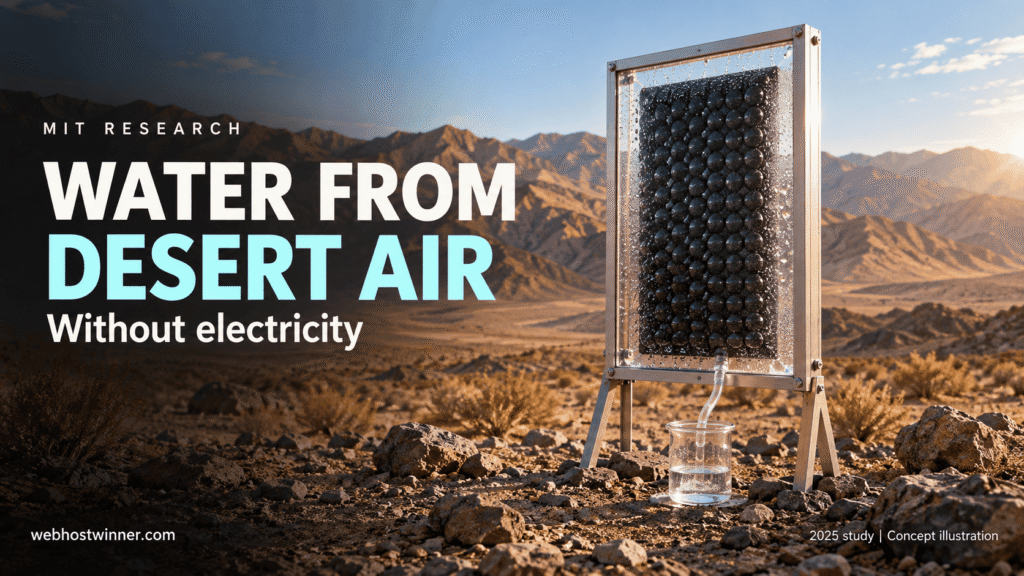
A panel about the size of a window stood in Death Valley and collected water from the air without an electrical supply. MIT reported the experiment in June 2025. MIT’s research announcement
Its daily collection was modest: between 57 and 161.5 millilitres. That is less than a small bottle of water, even at the upper end. The results appeared in Nature Water. The original study
Both details matter. Collecting water this way is interesting. Understanding the quantity helps explain what the technology could realistically become.
How the panel collects water
Inside the device is a hydrogel, a soft material that takes up moisture. The researchers shaped it into small domes to provide more exposed surface.
The daily cycle has three stages:
- At night, the material absorbs water vapour from the surrounding air.
- During the day, sunlight helps release the captured moisture as vapour.
- The vapour condenses on glass, and the liquid drains into a collection tube.
A cooling coating helps the glass act as a surface for condensation. Sunlight supplies energy to the process, while the device operates without an electrical connection. MIT’s explanation of the design
What the measured output means
The published experiment gives useful boundaries for the claim.
| Measurement | Reported result |
|---|---|
| Daily water collection | 57 to 161.5 millilitres |
| Relative humidity during testing | 21% to 88% |
| Lithium concentration in collected water | Below 0.06 parts per million |
| Study publication | 11 June 2025 |
These figures describe the study’s conditions. The humidity varied; the upper daily yield should not be read as a guaranteed result at the lowest humidity. Study abstract and publication details
For perspective, sustaining the highest reported daily yield would fill a 500 millilitre bottle in about three days. At the lowest yield, it would take almost nine days. That is a simple calculation from the published range, not a forecast for another location.
Those volumes do not demonstrate a complete household supply.
Why the water quality result matters
The study also addressed lithium contamination, reporting concentrations below 0.06 parts per million in the collected water. Producing a measurable amount of water and checking its composition are both necessary parts of evaluating a proposed drinking water technology. Water quality result
A future installation would also need to manage the water after collection. Storage, handling and delivery are part of the system people actually use.
The World Health Organization describes safely managed drinking water as coming from an improved source, being available on the premises when needed, and being free from faecal and priority chemical contamination. Its approach to water safety covers risks throughout the journey from source to consumer. WHO guidance on drinking water
For a household, reliability includes opening the tap when water is needed and knowing the supply has been managed properly.
Where fog nets fit into the picture
Another way of collecting atmospheric water uses large mesh nets. These intercept tiny liquid droplets carried in fog, allowing the droplets to gather and drain into a collector. Their performance depends on factors including the mesh structure and the fog passing through it. MIT’s explanation of fog collection
The hydrogel panel collects water vapour through a different process. These approaches should be assessed against the conditions they need. A photograph of a successful installation in one place cannot establish which design would suit another.
What would make this useful outside an experiment
For anyone assessing a pilot project, the next questions are practical:
How much usable water arrives over a whole season? A daily record should show weak periods as well as strong ones. That allows planners to estimate storage and backup requirements.
What does each litre cost over the equipment’s life? Include installation, maintenance, replacement materials and water quality checks in the comparison.
Who will maintain it? A pilot should have a named operator, clear instructions and access to replacement parts.
What service is the system intended to provide? A supplementary supply, an emergency reserve and a household’s main source of water require different levels of capacity and reliability.
These are proposed evaluation questions, rather than additional results from the MIT experiment. They help turn an appealing idea into a project that can be judged against a specific need.
It is also worth asking what improvement would matter most at the intended site. More output may be the priority in one location. Easier maintenance or a lower replacement cost may be more valuable elsewhere. A useful trial should define those priorities before equipment is installed.
The panel offers a concrete research result to build on. The next meaningful demonstration would show how much dependable, usable water a larger system can deliver, what it costs, and how people can keep it working.