Last Updated on September 14, 2026 by Gavi
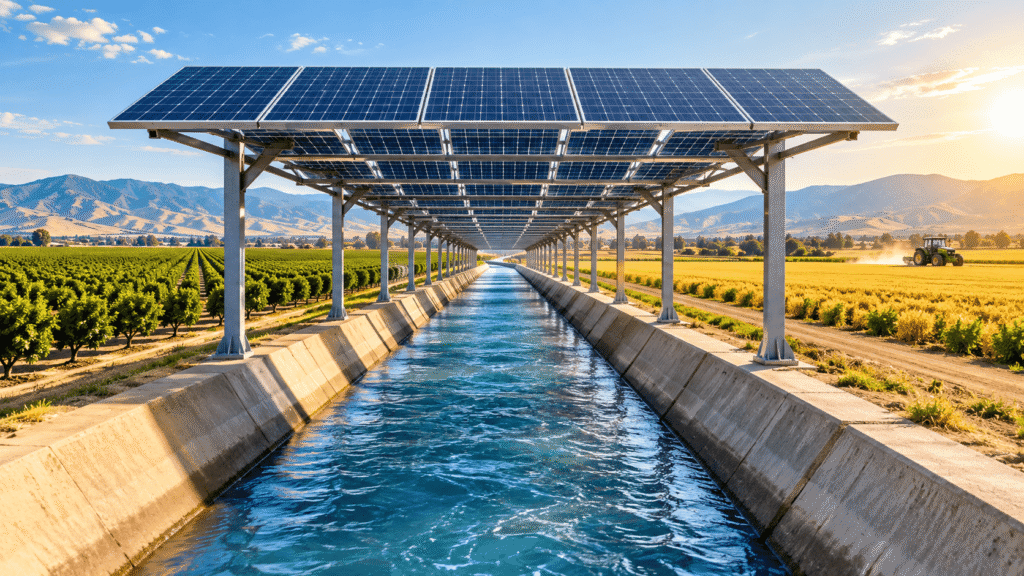
California is putting solar panels above water on its way to farms. The panels generate electricity, and their shade helps keep some of that water in the canal.
In April 2026, UC Merced reported early results from Project Nexus showing up to 70% less evaporation in shaded canal sections. The finding gives a practical reason to look at the space above existing waterways when planning solar installations. These are preliminary pilot results, and the percentage refers specifically to evaporation in the shaded sections. University of California project update.
How solar panels help conserve water
The panels sit on structures above the canal, leaving water free to move underneath. They provide shade and some protection from wind, helping reduce evaporation while producing electricity.
Turlock Irrigation District, the operator involved in Project Nexus, explains that the approach uses existing water delivery infrastructure and access to the electricity grid. It also gives researchers an opportunity to investigate how shade affects vegetation in the canals. Turlock Irrigation District project details.
The space is already doing one job: carrying water. Adding a solar canopy allows it to do another. For suitable locations, that can reduce the need to set aside a separate area for a solar array.
Where the 82% figure came from
The larger number often shared online has a research basis.
In 2021, UC Merced reported a study projecting evaporation reductions of as much as 82%. Its statewide scenario estimated that covering roughly 4,000 miles of California canals could conserve about 63 billion US gallons of water annually and accommodate around 13 gigawatts of solar capacity. Those figures describe a potential deployment across the canal network. UC Merced’s 2021 research announcement.
The original paper, published in Nature Sustainability, used regional hydrological and financial simulations. It examined how water savings and other benefits could affect the economics of solar installations above canals. Its financial results depend on the designs, locations and assumptions modelled. Original research paper.
The distinction is useful when reading a headline. The 82% figure is a projection from the earlier research. The later report of up to 70% comes from early observations of the pilot. Neither percentage is a guaranteed saving for every canal.
The pilot is already operating
According to Turlock Irrigation District, both Project Nexus locations were fully commissioned by August 2025. The installations cover canal sections of different widths, allowing the project to examine more than one structural arrangement.
The partnership includes the district, the California Department of Water Resources, Solar AquaGrid and UC Merced. Its research covers water conservation, renewable electricity, maintenance and energy storage. Project Nexus overview.
The practical challenge is access
An irrigation canal still needs to be inspected and maintained after the panels go up.
When the pilot was announced in 2022, UC Merced identified several issues to investigate: the cost of supporting structures, access for canal maintenance and getting the generated electricity to a useful destination.
These details influence whether a location is suitable and whether the installation makes financial sense. A design that produces power must also allow the canal operator to keep delivering water and carrying out necessary work. UC Merced’s explanation of the pilot and its engineering challenges.
How the project should be assessed
A useful assessment would put the electricity output and water savings alongside the costs of the structure and its upkeep.
For anyone considering a similar project, a practical starting point would be to compare:
Electricity delivered over a full operating year.
Water retained through reduced evaporation, measured across seasons.
Changes in the time and cost of canal maintenance.
Construction, repair and grid connection costs.
These are proposed evaluation criteria, rather than additional results from Project Nexus. They would help explain where a solar canopy provides enough value to justify building one.
The early findings give this idea substance. A canal can continue delivering water while the space above it produces electricity. The value of the installation should include both services.