Last Updated on September 15, 2026 by Gavi
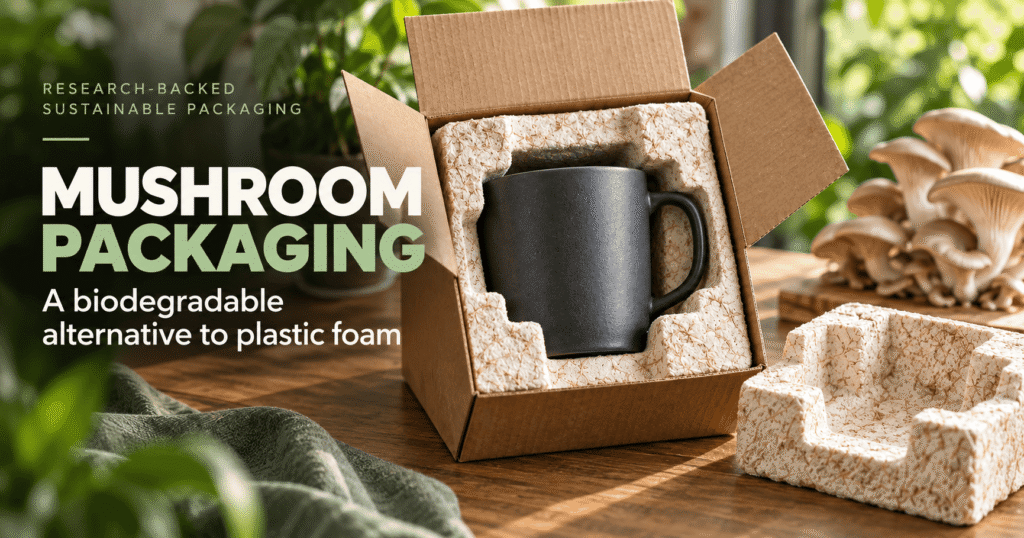
The protective material around your next fragile delivery might not be made from plastic foam.
It could be grown.
Mushroom® Packaging, originally developed by Ecovative, uses mycelium – the thread-like network produced by fungi – to bind plant material into rigid protective forms. Rather than melting petroleum-based polymers into foam, the material grows inside a mould shaped around the product it is intended to protect.
Despite the name, the packaging is not made from ordinary mushrooms. The important part is the mycelium, a network of microscopic fungal filaments known as hyphae.
Research into these materials is now examining something much bigger than an unusual packaging idea: whether biological growth can become a practical manufacturing process.
How mushroom packaging is grown
The current Mushroom® Packaging process uses two primary ingredients: hemp hurd and mycelium. Hemp hurd is the woody inner portion left after fibre is separated from the hemp plant.
The production process is surprisingly different from conventional foam manufacturing.
First, a mould is designed around the item that needs protection.
The mould is then filled with a mixture containing hemp hurd and mycelium. According to Mushroom Packaging, the material grows inside the mould for about four days. It is then removed and allowed to continue growing for another two days, helping form its outer surface.
Finally, the finished component is dried. This removes moisture and stops further fungal growth, producing a stable packaging part ready for use. The full growth and drying cycle takes roughly seven days.
In simple terms:
plant material + mycelium → biological growth → moulded structure → drying → protective packaging
The mycelium is effectively acting as a biological adhesive.
Why mycelium can hold the material together
A 2024 review published in Discover Materials explains that mycelium can grow through lignocellulosic materials and connect separate particles into a solid composite.
Researchers have experimented with substrates including straw, sawdust, coffee husks, wheat bran, bagasse and other agricultural residues.
As the fungal network expands through this material, its hyphae form an interconnected structure around the particles.
That is what turns loose agricultural material into something that can be handled as a single object.
But the final properties are not fixed.
Research shows that performance can change substantially depending on:
- the fungal species or strain
- the plant material used
- growth conditions
- moisture and temperature
- density and compression
- drying and post-processing methods
Those variables influence characteristics such as strength, density, thermal behaviour, water absorption and fire performance.
That makes mycelium packaging less like simply replacing one material with another and more like engineering a biological composite for a particular job.
How does it compare with expanded polystyrene?
The important question is not simply whether mycelium packaging is biodegradable.
It is whether its environmental performance is actually better when the full production and disposal process is considered.
A 2023 study published in Procedia CIRP compared packaging inserts made from hemp-and-mycelium composite with conventional expanded polystyrene (EPS).
The researchers carried out a gate-to-grave life-cycle assessment using methods including Cumulative Energy Demand and 100-year Global Warming Potential.
For the system they modelled, the EPS inserts required roughly twice as much cumulative energy as the mycelium inserts. The calculated global-warming impact of the EPS system was also more than twice that of the mycelium alternative.
That result is significant, but it does not mean every piece of mycelium packaging automatically has half the carbon footprint of every piece of plastic foam.
The outcome depends on manufacturing methods, electricity sources, transportation, geometry, material density and assumptions about what happens after disposal.
And the study identified trade-offs.
The mycelium inserts produced higher modelled impacts for stratospheric ozone depletion and marine eutrophication, while land-use impacts were relatively similar.
That is exactly why life-cycle assessment matters: an environmental alternative should not be judged on one attractive feature alone.
Newer research gives a similar – but more nuanced – picture
A 2025 study compared mycelium bio-foam and EPS packaging designed to protect a 32-inch television.
The calculated global-warming potential for the mycelium designs ranged from 1.32 to 3.24 kg CO₂-equivalent, depending on the material configuration, compared with 3.35 kg CO₂-equivalent for EPS.
But the researchers also found an important disadvantage.
The mycelium packaging was heavier, which increased its transportation impact compared with EPS.
This means reducing density and unnecessary material could be just as important as changing the material itself.
A sustainable package that requires substantially more mass to perform the same job can lose part of its environmental advantage during transportation.
What happens after the package is used?
End-of-life is one of the strongest differences between mycelium composites and petroleum-based protective foam.
Mushroom Packaging states that its current product is home compostable, with the company specifying approximately 45 days under suitable composting conditions.
That figure should not automatically be applied to every mycelium material produced by every manufacturer. Formulation, thickness, coatings and environmental conditions can affect degradation.
But the basic material concept provides an interesting circular-economy pathway: agricultural material can be used as a feedstock, turned into a protective product and then biologically broken down after use.
That is fundamentally different from designing a disposable packaging component around a material intended to remain stable for decades.
Mycelium packaging still has limitations
Mycelium is promising, but it is not a universal replacement for plastic.
Moisture remains important. Mushroom Packaging itself notes that repeated saturation or immersion can reduce the material’s rigidity.
Research also shows that material properties can vary with fungal strain, feedstock and production conditions. That variability creates a challenge when manufacturers need predictable mechanical properties at large scale.
Drying is another factor. The 2023 life-cycle study identified electricity use – including energy associated with drying – as an important contributor to the environmental impact of mycelium production.
And not every packaging application is appropriate. Mushroom Packaging states that its product is not certified for direct food contact, for example.
The real engineering challenge is therefore not simply:
Can fungi replace plastic?
It is more specific:
Can a mycelium composite deliver the necessary protection, at the necessary weight and cost, while creating a lower total environmental impact?
Research suggests that for some protective-packaging applications, the answer may already be yes.
A different way of thinking about manufacturing
The most interesting part of mushroom packaging may not be the finished object.
It is the manufacturing idea behind it.
Traditional manufacturing normally starts by extracting raw materials and using heat, pressure or chemical processes to force them into the required shape.
Mycelium-based manufacturing uses biological growth to help create that structure.
Ecovative began developing mycelium materials at Rensselaer Polytechnic Institute in 2007, and Mushroom® Packaging was commercially launched in 2010. The technology was later licensed to other producers.
More than a decade later, scientific research is continuing to investigate mycelium composites for packaging, insulation, construction, acoustic materials and other applications.
The bigger lesson is not that every piece of plastic foam will suddenly disappear.
It is that waste plant material, fungi and carefully controlled biological processes can be engineered into materials capable of doing work once reserved almost entirely for petroleum-based polymers.
And that makes mushroom packaging worth watching.
More sustainability innovations
Another approach is using existing infrastructure for two purposes at once. In California, researchers are testing solar panels above irrigation canals, producing electricity while reducing water lost through evaporation.
Solar Panels Over Canals Are Saving Water in California
Researchers at MIT have also demonstrated a passive panel capable of collecting water from desert air without an electrical connection, using a specially designed hydrogel.
This MIT Panel Collected Water From Desert Air Without Electricity
Research and sources
Ecovative — history of Mushroom® Packaging
Ecovative: Earlier Work
Mushroom Packaging — manufacturing process
How Mushroom Packaging Is Grown
Madusanka et al. (2024) — review of fungal mycelium composites
A Review of Recent Advances in Fungal Mycelium Based Composites
Enarevba & Haapala (2023) — life-cycle comparison with expanded polystyrene
A Comparative Life Cycle Assessment of Expanded Polystyrene and Mycelium Packaging Box Inserts
Zoungrana, Hausner & Yuan (2025) — mycelium bio-foam versus EPS
Sustainability Assessment of Mycelium Bio-Foam Packaging