Last Updated on September 15, 2026 by Gavi
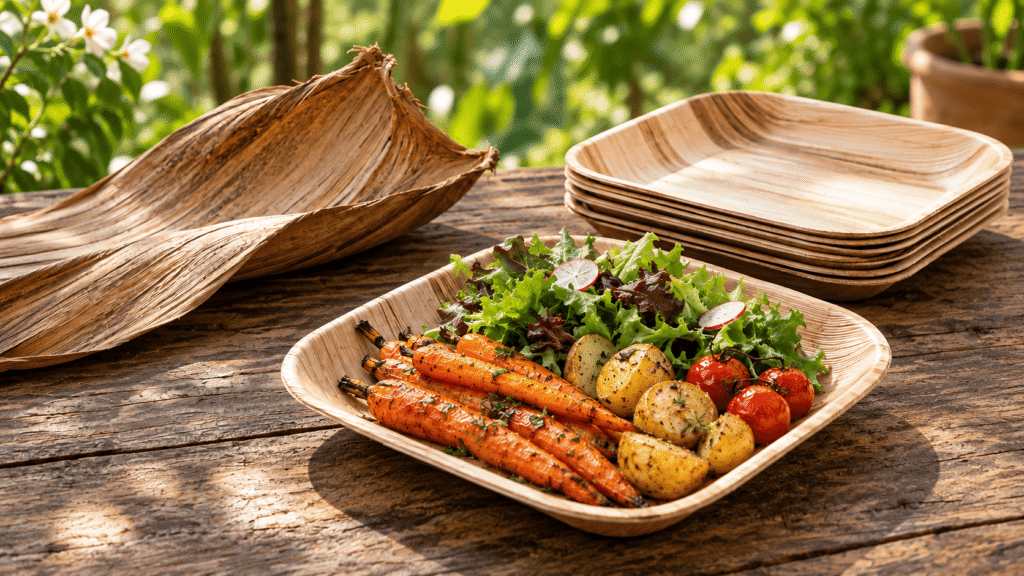
A leaf that would normally fall to the ground can become the plate your lunch is served on.
VerTerra produces disposable plates, bowls and trays from naturally fallen palm leaves, shaping them with heat, steam and pressure rather than relying on conventional plastic or paper manufacturing.
The idea sounds simple.
But behind the finished plate is an interesting example of how an agricultural by-product can be turned into a useful material before eventually returning to a biological waste stream.
And unlike many products marketed as “green,” palm-leaf tableware has also been examined through life-cycle assessment and materials research.
How can a fallen leaf become a plate?
VerTerra says its palm-leaf dinnerware is produced in India from naturally fallen leaves.
The company developed a manufacturing process in which moisture, temperature and pressure are carefully controlled to transform the leaves into stable shapes.
According to VerTerra, its process eventually evolved into a 16-step system using steam, heat and pressure without chemical binders.
The principle is straightforward:
fallen leaf → cleaning → moisture/steam → heated mould → pressure → finished plate
Instead of grinding the plant material into pulp and rebuilding it into a new sheet, much of the original leaf structure remains.
That is why the veins, fibres and colour variations are still visible in the finished product.
Every plate can look slightly different.
The material already has a useful structure
There is a scientific reason these leaves can work as tableware.
Research on areca palm leaf sheaths — the material commonly used in this type of foodware — shows a naturally organised fibre-and-matrix structure.
Researchers studying areca sheath material using X-ray imaging found vascular fibre bundles distributed through a porous plant matrix.
That internal structure contributes to the material’s mechanical behaviour.
It means the manufacturer is not starting with a completely shapeless raw material.
The plant has already produced a lightweight composite structure.
Manufacturing mainly modifies its shape and moisture condition so that it can function as foodware.
Water is actually part of the manufacturing science
One particularly interesting study investigated how water moves through areca palm leaf sheath.
The researchers found that water absorption affects the material in two competing ways: it can reduce stiffness while increasing formability.
That helps explain why moisture and heat are useful during manufacturing.
A dry leaf sheath would be more difficult to form into a deep bowl or curved plate without cracking.
Introducing moisture makes the material easier to shape.
Once pressed into its final geometry and dried, it becomes more suitable for handling food.
The researchers also found that water travelled through the internal matrix considerably faster than through the fibres, showing that the seemingly simple leaf actually has a complex internal structure.
This is a good example of something often missed in sustainability discussions:
the environmental idea may be simple, but the material science is not.
VerTerra does not use conventional coatings or glue
Many disposable plates require binders, coatings or layers to give them strength or resistance to liquids.
VerTerra states that its palm-leaf products are made using fallen leaves, steam, heat and pressure without added bonding agents or lacquers.
The Biodegradable Products Institute also describes VerTerra’s fallen-leaf products as being made without chemicals, lacquers or bonding agents.
VerTerra says careful control of heat and pressure helps preserve the leaf’s natural wax layer, which contributes to its resistance to moisture and oil.
That matters because a disposable plate still has to perform its basic job.
A material can be renewable and biodegradable, but if it becomes soggy immediately after food is added, it will not be a realistic substitute.
What does the life-cycle research show?
One of the most useful studies looked beyond whether palm-leaf plates are biodegradable and asked a more important question:
What is their environmental impact across their life cycle?
A 2020 study published in Energy Reports evaluated boxes, bowls and plates manufactured from Areca palm sheath waste in southern India.
The researchers calculated a carbon footprint of approximately 1,033 kg CO₂-equivalent per tonne of areca plates in the system they studied.
When compared with plastic plates, the researchers found that the areca-palm plates produced lower impacts across most of the environmental categories assessed.
There were exceptions: the palm products performed worse in the study’s ozone-depletion and terrestrial-toxicity categories.
That distinction is important.
It would be inaccurate to say:
“Palm-leaf plates have almost no environmental impact.”
They still require manufacturing, electricity and transportation.
A better conclusion is:
Using an agricultural residue can reduce several environmental impacts compared with conventional plastic tableware, but the full production system still matters.
Transportation matters more than it might seem
The same life-cycle assessment identified transportation, international shipping and electricity generation as major contributors to environmental impacts.
That creates an interesting sustainability trade-off.
The raw material may be a naturally fallen agricultural residue.
But if finished plates are manufactured thousands of kilometres away and shipped internationally, transportation becomes part of their footprint.
This is why sustainability cannot be judged only by looking at what an object is made from.
You also have to ask:
Where was it produced?
What energy was used?
How far was it transported?
How heavy is it?
And what happens after someone throws it away?
Are palm-leaf plates really compostable?
VerTerra’s palm-leaf products are listed through the Biodegradable Products Institute, which maintains certification records for commercially compostable products.
VerTerra also states that its palm-leaf dinnerware is BPI-certified compostable.
But “compostable” needs context.
A compostable product gives its strongest environmental benefit when it actually enters an appropriate composting system rather than being mixed with ordinary landfill waste.
That makes waste infrastructure part of the product’s environmental performance.
A compostable plate used somewhere with no collection or composting pathway does not automatically create a circular system simply because the material itself is capable of decomposing.
The disposal system matters almost as much as the material.
Palm leaves are part of a wider move toward agricultural waste
Palm-leaf tableware is not an isolated experiment.
Researchers are investigating many agricultural by-products as potential alternatives to conventional disposable packaging.
A scientific review of disposable food packaging identifies by-products from areca palm, banana, coconut, sal trees and other plants as possible raw materials for biodegradable takeaway containers.
Other research is examining agricultural residues such as cereal bran, fruit waste and plant fibres for packaging applications.
The broader idea is simple:
Instead of extracting a new fossil resource to manufacture a product that may be used for twenty minutes, researchers and manufacturers are asking whether an existing biological by-product can perform the same function.
Palm-leaf plates are one practical example of that approach.
But disposable is still disposable
There is another important point.
Replacing a plastic disposable item with a plant-based disposable item does not remove the environmental impacts associated with single-use consumption.
Reusable plates can often be preferable where washing and reuse are practical.
Palm-leaf products make the most sense in situations where disposable tableware is genuinely required — for example, some outdoor events, temporary food services or locations without suitable washing infrastructure.
In those situations, the comparison changes from:
reusable plate vs palm plate
to:
plastic disposable plate vs plant-based disposable plate
That is where palm-leaf products become especially interesting.
The natural texture is more than decoration
One unusual feature is that the original structure of the leaf remains visible.
The streaks, fibres and colour variations seen on a palm-leaf plate are not printed patterns designed to make it look environmentally friendly.
They are part of the source material.
That gives every item a slightly different appearance.
It also makes the product a visible example of material reuse: consumers can immediately see that the object they are holding was once plant material.
A simple material with a useful second life
The concept behind palm-leaf dinnerware is not that a new high-tech material has been invented.
In many ways, it is the opposite.
A material already produced by a tree is collected after it falls, cleaned, softened, shaped and given another useful life.
The scientific research adds an important layer to that story.
Palm sheath has a naturally reinforced structure.
Moisture makes it easier to form.
Heat and pressure allow it to become practical tableware.
And life-cycle research suggests that areca-palm products can have lower impacts than plastic alternatives across several environmental categories, although transportation, electricity and end-of-life treatment still matter.
A fallen leaf may look like waste.
But with relatively simple processing, it can become something useful before returning to the biological cycle.
And that is a much more interesting story than simply calling a plate “eco-friendly.”
More sustainability innovations
Packaging materials are changing in other unusual ways too.
Mushroom packaging uses mycelium to bind plant material into protective forms that can substitute for some conventional plastic foams.
Another approach is using existing infrastructure twice: California’s solar-over-canal projects generate electricity while also reducing evaporation from irrigation canals. Your recent article explains the early Project Nexus results in more detail.
Researchers at MIT have also demonstrated a passive hydrogel panel capable of collecting water from desert air without being connected to an electrical supply.
Read: Solar Panels Over Canals Are Saving Water in California
Read: This MIT Panel Collected Water From Desert Air Without Electricity
Research and sources
VerTerra – manufacturing process and company history
The company explains its use of naturally fallen palm leaves and its steam, heat and pressure manufacturing process.
Biodegradable Products Institute – VerTerra certification listing
BPI lists VerTerra and describes its fallen-leaf foodware manufacturing approach.
Pavithra et al. – Diffusion of Water in Palm Leaf Materials
The study examines the microstructure and water behaviour of areca palm sheath used to manufacture plates and bowls.
A 2020 life-cycle assessment in Energy Reports
Researchers compared areca-palm containers with disposable plastic alternatives and identified both environmental advantages and important trade-offs.