Last Updated on September 15, 2026 by Gavi
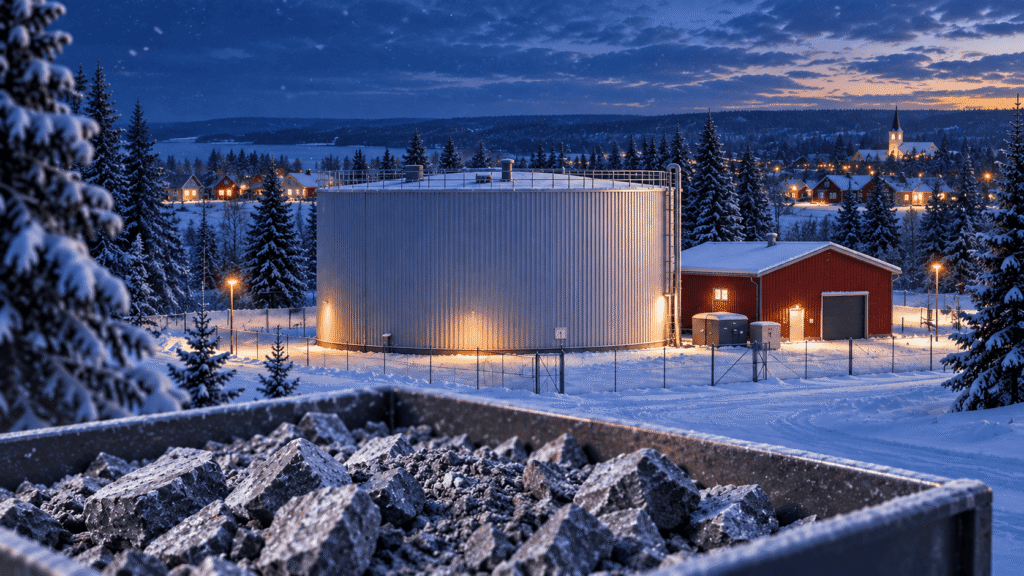
In a small Finnish municipality, part of the heating system now depends on something surprisingly simple.
Stone.
Inside a large insulated silo in Pornainen sit around 2,000 tonnes of crushed soapstone. Electricity is converted into heat, that heat is stored in the stone, and it can later be released into the local district heating network when buildings need warmth.
The system, developed by Finnish company Polar Night Energy for district heating operator Loviisan Lämpö, entered operation in June 2025.
One year later, Polar Night Energy reported that climate emissions from the Pornainen district heating network had fallen by 70 percent. Biomass consumption fell by 60 percent, heating oil consumption fell by 100 percent, and district heating supply reliability was reported at 100 percent.
It is called a Sand Battery.
But there is an important detail.
There is no ordinary sand inside this one.
What is actually inside the Sand Battery?
The Pornainen system uses crushed soapstone, a material left over from the production of heat retaining fireplaces by Finnish manufacturer Tulikivi.
Instead of requiring a newly manufactured storage medium, the project uses around 2,000 tonnes of this industrial byproduct. Polar Night Energy says that amount is comparable to the stone used in roughly 1,000 soapstone fireplaces.
That gives the project an additional circular economy element.
A material left over from one manufacturing process becomes the thermal storage medium for another energy system.
The name Sand Battery refers more to the technology than the exact material. Polar Night Energy says the system can work with sand and other suitable granular materials that can tolerate repeated heating.
How can stone store energy?
The principle is much simpler than an electrochemical battery.
Electricity enters the system.
Electrical resistors heat air.
That hot air circulates through pipes inside the storage material and transfers thermal energy into the stone.
When heat is required, cooler air moves through the pipes again. The air absorbs heat from the stone and carries it to a heat exchanger, where the energy can be transferred to water used by the district heating network.
So the energy pathway looks like this:
Electricity → hot air → heated stone → hot air → hot water → buildings
Nothing inside the stone needs to undergo the type of chemical reaction that takes place inside a lithium ion battery.
The stone simply becomes hotter.
In engineering terms, this is sensible heat storage. Energy is stored by increasing the temperature of a material and recovered as that material cools.
Packed beds of rock and similar solids have been studied for thermal storage for years because inexpensive solid materials can tolerate high temperatures and store substantial amounts of heat. Research has identified packed bed thermal storage as a promising approach for applications where heat, rather than electricity, is the final product.
How large is the system?
The Pornainen installation is approximately 13 metres high and 15 metres wide.
Its thermal storage capacity is 100 MWh, while its heating power is 1 MW.
Those two numbers describe different things.
The 100 MWh figure tells us how much thermal energy the system can store.
The 1 MW figure describes how quickly it can deliver heat at its rated output.
Polar Night Energy says the stored energy corresponds to approximately one month of Pornainen’s heat demand during summer or approximately one week during winter.
That is an important distinction from many electrical batteries, which are designed around much shorter discharge periods.
Here, the goal is to hold large amounts of heat until the heating network needs it.
Why store electricity as heat instead of electricity?
Because the town ultimately needs heat.
Converting electricity into heat is straightforward. If that heat can be stored efficiently, there is no need to convert it back into electricity before using it to warm buildings.
This avoids solving a more difficult problem than necessary.
Pornainen already has a district heating network. Hot water can be distributed through that network to buildings including the municipal office, school and library.
The Sand Battery therefore connects electricity markets with heat demand.
When suitable electricity is available, the storage can charge.
When the town needs heat later, it can discharge.
Academic research on thermal energy storage in district heating systems has highlighted exactly this advantage. Storage can help heating networks respond to changing energy prices, renewable generation and changing heat demand rather than requiring heat to be produced at the same moment it is consumed.
The electricity does not have to be bought when it is expensive
This may be one of the most important parts of the project.
The Sand Battery does not simply switch on whenever heat is required.
Its charging can be moved to more favourable periods.
Polar Night Energy says charging is controlled using algorithms designed to minimise electricity costs while still ensuring future heating demand can be met. The system can also participate in Finland’s electricity reserve markets.
According to the project’s first year report, electricity used to charge the storage was purchased at prices around 70 to 80 percent below the average spot market price on average. In some months, the reported difference exceeded 90 percent.
That does not mean electricity itself became cheaper.
It means storage gave the operator more freedom over when electricity was purchased.
Without storage, heating demand and electricity purchasing are closely connected in time.
With storage, they can be separated.
The system can buy energy during more favourable periods and keep the heat until it is needed.
What happened during the first year?
This is where the Pornainen project becomes especially interesting.
It is no longer simply a proposal or demonstration under construction.
It has completed a full year of operation.
Polar Night Energy reported the following results after the first year:
- 70 percent reduction in climate emissions from the district heating network
- 60 percent reduction in biomass consumption
- 100 percent reduction in heating oil consumption
- More than 85 percent efficiency
- 100 percent district heating supply reliability
The system also became the primary production facility for Pornainen’s district heating network.
The Municipality of Pornainen has separately published the same first year results.
One point deserves particular emphasis.
The 70 percent figure refers to climate emissions from the district heating network, not a 70 percent reduction in all emissions produced by the municipality.
That distinction matters when interpreting the result.
These are also project reported operational figures from Polar Night Energy and its partners rather than the results of a peer reviewed field study.
Even with that qualification, completing a full year as a primary district heating source provides far more useful evidence than a laboratory demonstration alone.
Why did emissions fall?
The battery itself does not magically eliminate emissions.
Its environmental benefit comes from changing how heat is produced.
Before the project, the local system relied more heavily on combustion.
The Sand Battery allows electricity to replace much of that combustion based heat production.
The existing woodchip plant can remain available for backup and periods of high demand, but its fuel consumption can be reduced. Heating oil use was reported to have disappeared entirely during the first year.
The carbon benefit therefore depends partly on the electricity used for charging.
If a thermal battery were repeatedly charged using highly carbon intensive electricity, its emissions advantage would be smaller.
If charging can increasingly coincide with cleaner renewable generation, the environmental case becomes stronger.
Why thermal storage matters as wind and solar grow
Wind and solar power do not necessarily generate electricity at exactly the moment energy demand peaks.
Storage helps separate energy production from energy use.
Most public discussion about storage focuses on electrical batteries.
But much of the world’s energy demand is actually for heat.
Buildings require heating.
Factories require steam.
Food production requires thermal energy.
Chemical processes require high temperatures.
If electricity is eventually going to become heat, storing some of that energy directly as heat can make sense.
A 2026 review in the Journal of Energy Storage examined sand based thermal energy storage and concluded that large systems can approach efficiencies around 90 percent while offering potential for district heating and industrial heat applications. The researchers also noted that economics depend strongly on factors including electricity prices, utilisation, storage costs and system design.
That last point is important.
There is no universal rule saying a Sand Battery will be economical everywhere.
Local electricity markets, heating infrastructure, temperatures, storage duration and competing technologies all matter.
Why use stone rather than lithium?
A Sand Battery and a lithium ion battery solve different problems.
Lithium batteries are extremely useful when electricity needs to be stored and returned as electricity.
The Pornainen system is primarily storing energy for heat.
For that task, inexpensive rock can offer an interesting advantage.
The storage medium does not require lithium, nickel or cobalt.
It does not need to perform an electrochemical reaction.
And in Pornainen, the storage material is an industrial byproduct that already existed.
That does not make thermal storage environmentally impact free.
The silo has to be constructed.
Pipes, insulation, electrical equipment and heat exchangers require materials.
Electricity is consumed during operation.
The system also requires fans, controls and maintenance.
But the storage medium itself can be remarkably simple.
Sometimes the useful innovation is not inventing a new material.
It is finding a better use for an ordinary one.
The bigger opportunity may be industry
Heating homes is only one possible application.
Many industries still burn fossil fuels because they require reliable heat or steam at temperatures that are difficult to electrify economically.
Polar Night Energy sees industrial process heat as a major future market for the technology.
Academic research points in the same general direction.
Recent analysis of sand thermal energy storage suggests that it could become useful for high temperature heat applications where inexpensive renewable electricity can be stored as thermal energy and supplied later.
That could include processes in food manufacturing, chemicals and other heat intensive industries.
The challenge is not simply storing energy.
It is storing the right form of energy for the job that needs to be done.
For Pornainen, that job is heating buildings.
And 2,000 tonnes of crushed stone appear to be doing it.
A useful first year, but not the final answer
The most interesting part of the Pornainen project is not that stone can become hot.
Humans have understood that for a very long time.
The innovation is combining familiar physics with modern electricity markets, automated control, district heating infrastructure and large scale thermal storage.
Electricity can be purchased when conditions are favourable.
Heat can be stored for later.
An industrial byproduct becomes the storage material.
And combustion can be reduced.
After one year, the project developer reports a 70 percent reduction in district heating climate emissions, complete elimination of heating oil consumption and uninterrupted heat supply.
Longer operating histories will tell us more about maintenance, economics and performance over many thermal cycles.
But Pornainen has already demonstrated an important idea.
Not every energy storage problem requires a sophisticated chemical battery.
Sometimes you can store the energy in 2,000 tonnes of stone.
More sustainability innovations
Another project is using existing infrastructure for two purposes at once. In California, solar panels installed above canals can generate electricity while also reducing evaporation.
Read: Solar Panels Over Canals Are Saving Water in California
MIT researchers have also demonstrated a passive system designed to collect water from extremely dry air using a specialised hydrogel material.
Read: This MIT Panel Collected Water From Desert Air Without Electricity
Read: Fallen Palm Leaves Are Being Turned Into Plates – What the Research Shows
Read: Mushroom Packaging Is Replacing Plastic Foam
Research and sources
Polar Night Energy: First year results, June 2026
Reports the 70 percent reduction in heating network climate emissions, more than 85 percent efficiency, 60 percent reduction in biomass use and elimination of heating oil consumption.
Polar Night Energy: Pornainen project details
Includes the 100 MWh storage capacity, 1 MW heating power and 2,000 tonnes of crushed soapstone.
Polar Night Energy: Sand Battery technology
Explains how electricity heats air, how heat is stored in stone and how that heat is later recovered.
Municipality of Pornainen: First year results
Local government announcement covering the reported performance after one year of operation.
Journal of Energy Storage: Research on sand thermal energy storage
Reviews the performance, economics and potential applications of sand based thermal energy storage.
Applied Energy: Thermal energy storage in district heating networks
Reviews how thermal storage can support district heating systems and help separate energy production from heat demand.