Last Updated on September 16, 2026 by Gavi
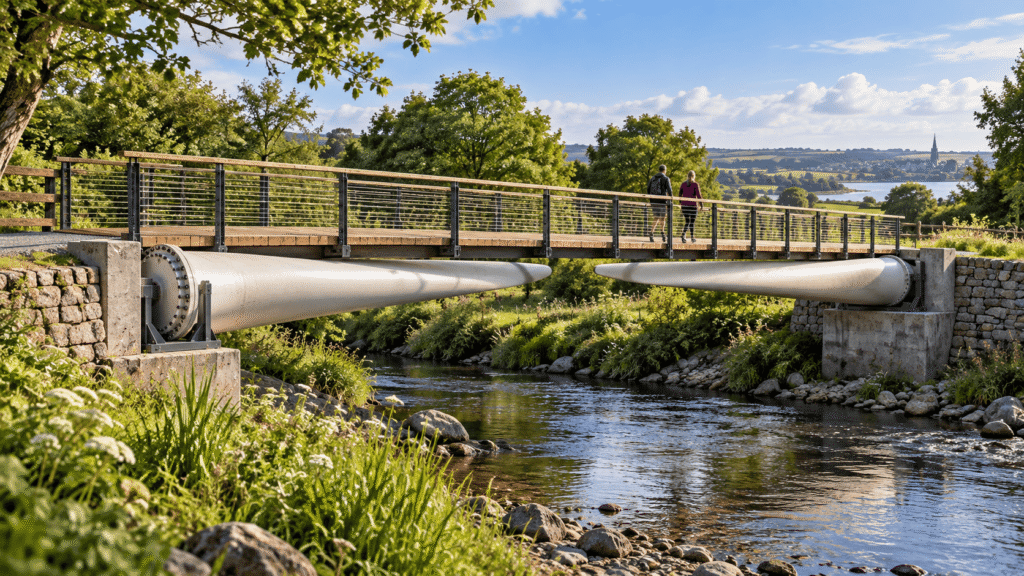
A wind turbine blade can spend decades helping produce renewable electricity.
When the turbine reaches the end of its working life, however, the blade creates a difficult question.
What do you do with a structure that may be tens of metres long, extremely strong, resistant to weather and made from composite materials that are difficult to separate?
In County Cork, Ireland, researchers and engineers found an unusual answer.
They turned retired turbine blades into part of a bridge.
Two former wind turbine blades now act as the main supporting girders of a pedestrian and cycle bridge on the Midleton to Youghal Greenway.
The 5.5 metre bridge crosses a flood channel of the Dungourney River, around three kilometres from Midleton train station. The BladeBridge project states that two LM13 blades sourced from Northern Ireland were used instead of conventional steel girders. The bridge was commissioned by Cork County Council and completed in January 2022.
It is a striking example of a circular economy idea that is becoming increasingly important.
Instead of immediately breaking an old product down into raw materials, can we preserve the engineering value already built into it?
Why wind turbine blades create a waste problem
Wind turbines are associated with renewable electricity, but the turbines themselves still contain materials that eventually reach the end of their original service lives.
Wind turbine blades are particularly difficult.
Most modern blades use fibre reinforced polymer composites. These materials combine reinforcing fibres with a polymer matrix to create structures that are strong, relatively lightweight and resistant to fatigue.
Those characteristics are exactly what make them useful on a turbine.
They are also what make them difficult to recycle.
A review published in Green Chemistry explains that recovering useful materials from fibre reinforced polymer composites remains challenging because the different components are strongly bonded together. The review identifies reuse, recycling and recovery as important routes for managing growing quantities of retired blades.
Research from University College Cork estimated that about 53,000 tonnes of blade waste from onshore wind farms could potentially be generated in Ireland by 2040.
The issue is therefore not simply what to do with one old blade.
It is how renewable energy systems should manage large engineered components after their original job is finished.
Reuse is different from recycling
The Cork bridge demonstrates an important distinction.
The blades were not ground into small pieces and transformed into another material.
Their existing structure was retained and used again.
The Re Wind research network describes repurposing as taking a blade that has finished its life on a turbine and redesigning it for a different structural use, such as a bridge, transmission pole, sound barrier, shelter or seawall.
That preserves more of the value already contained in the blade.
Consider what has already gone into manufacturing one.
Raw materials have been extracted.
Fibres and resins have been produced.
The blade has been manufactured to demanding tolerances.
Energy has been consumed.
Transportation has occurred.
Engineering knowledge has been applied.
If the structure still has useful mechanical properties, destroying all of that embedded value immediately may not always be the most efficient option.
Repurposing asks whether the object itself can remain useful.
Why can a turbine blade support a bridge?
A wind turbine blade may look thin from a distance, but it is designed for demanding mechanical conditions.
During operation it experiences repeated bending, vibration, changing wind loads and exposure to rain, sunlight and temperature variation.
That requires significant structural strength.
The Re Wind team did not simply assume that retired blades could carry bridge loads.
Their work involved blade sourcing, geometric assessment, material testing, structural testing, engineering design and construction planning. A peer reviewed study published in Sustainability documents the design and construction process used for BladeBridge projects in Ireland and Northern Ireland.
More recent research strengthens the argument that useful structural capacity can remain after years of turbine service.
A 2025 study examined glass fibre reinforced polymer material removed from a wind turbine blade after 11 years in operation. In the longitudinal direction, the researchers found that several measured properties retained roughly 70 to 96 percent of the mechanical capacity of comparable pristine material, depending on the property examined.
That does not mean every retired turbine blade is suitable for construction.
Condition, damage, geometry, fibre orientation and previous service history all matter.
But it shows why engineers are interested in these structures after their first life is over.
There can still be considerable material value left.
The blades replaced steel girders
This is where the environmental case becomes especially interesting.
The County Cork bridge did not simply provide somewhere to store old turbine blades.
The blades performed a job that would otherwise have required another material.
According to University College Cork, using the decommissioned blades instead of conventional steel girders avoided nearly 800 kilograms of carbon dioxide emissions for this particular bridge project.
That benefit comes partly from avoiding production of new structural material.
Steel is highly recyclable, but producing structural steel still requires energy, processing and transportation.
When an existing engineered component can safely replace a newly manufactured component, the environmental benefit can come from both sides.
Waste is avoided.
New material demand is also reduced.
That same logic appears in other circular material systems.
For example, fallen plant material can be turned into disposable tableware rather than immediately becoming agricultural waste. You can see that approach in the WebHostWinner article on fallen palm leaves being turned into plates.
Another example uses fungal mycelium to bind plant material into protective packaging that can replace some petroleum based foams. Read more about mushroom packaging and the research behind it.
The materials are very different, but the principle is similar.
Extract more useful life from biological or industrial materials before demanding new resources.
What does life cycle research say?
One bridge cannot tell us whether repurposing will work at a larger scale.
That is where life cycle assessment becomes useful.
Researchers at University College Cork evaluated several possible second life applications for decommissioned turbine blades in Ireland.
Their study estimated that the scenarios analysed could save about 342 kilograms of carbon dioxide equivalent for every tonne of blade waste used.
Substituting blade material for steel products produced the largest greenhouse gas benefit among the options examined, followed by substitution for concrete products.
The study also provides an important reality check.
Repurposing alone is unlikely to absorb all future turbine blade waste.
Even if 20 percent of the projected material were reused annually in the scenarios studied, large quantities would still require other solutions.
That means blade bridges should not be presented as a complete answer to the wind industry waste problem.
They are one part of a broader strategy.
A second life still requires engineering
It is tempting to describe projects like this as simply putting old blades across a river.
The actual process is much more demanding.
Retired blades were originally designed for aerodynamic performance, not bridge construction.
Their geometry is curved.
Their wall thickness changes along their length.
Material composition can vary between sections.
Engineers therefore have to work with the component that already exists rather than ordering a new structural beam with standard dimensions.
The 2023 BladeBridge research identifies a sequence that includes project planning, blade sourcing, geometric characterisation, material testing, structural testing, design, cost estimation and construction.
This is an important point for circular design.
Reuse does not mean engineering standards disappear.
In many cases it requires even more detailed understanding of the material because engineers need to know what happened during its first life before approving it for another one.
The shape can become an advantage
A turbine blade is an unusual construction component.
It tapers.
It curves.
Its root section is much larger than its tip.
At first, those characteristics might seem like disadvantages.
But circular design often works best when designers stop trying to make a reused object behave exactly like a new conventional product.
Instead, they design around the characteristics already present.
The Re Wind project developed dozens of concepts for retired blades, not only bridges.
Potential applications have included transmission structures, shelters, street furniture, barriers and other infrastructure.
BladeBridge itself now shows projects involving bike shelters, picnic structures, planters, furniture and charging hubs made using retired blade material.
One blade therefore does not need to have only one possible second life.
Different sections may suit different uses.
Transport can determine whether reuse makes sense
There is also a practical limitation.
Wind turbine blades are enormous.
Moving them can be expensive and difficult.
A repurposing project may make environmental sense when the blades are available relatively close to where the new structure is being built.
The calculation can change when blades have to be transported very long distances.
This is why location matters in circular economy projects.
The environmental value of reuse depends not only on the material saved but also on what has to happen to make reuse possible.
Transport, cutting, testing, modification and construction all have environmental impacts.
The University College Cork life cycle work specifically considered material substitution and the role of local reuse when assessing possible second life applications.
The best use for a retired blade may therefore depend on what infrastructure needs exist nearby.
Recycling will still be necessary
Not every blade will become a bridge.
Some will be too damaged.
Some geometries will not suit available projects.
Some will be located too far from potential reuse applications.
Others will eventually reach the end of their second life.
Recycling technologies will therefore remain important.
Researchers are investigating mechanical processing, thermal methods, chemical recovery and use of composite waste in processes such as cement manufacture.
A University College Cork study comparing disposal routes for Irish blade waste found that material substitution can significantly influence the environmental outcome of blade management.
The wider goal should therefore be a hierarchy of options.
Keep the product useful when practical.
Repurpose useful sections.
Recover valuable materials where possible.
Minimise disposal.
The circular economy challenge for renewable energy
Wind power solves one environmental problem but does not eliminate material use.
Neither do solar panels, batteries or other clean energy technologies.
A low carbon energy system still needs steel, concrete, polymers, minerals and manufacturing.
The sustainability question is therefore becoming broader.
It is no longer enough to ask:
How much renewable electricity does this technology generate?
We also have to ask:
How long will the equipment last?
Can components be repaired?
Can they be reused?
Can materials be recovered economically?
What happens at the end of their useful life?
This is also visible in energy storage.
Finland, for example, has been developing thermal storage systems that store renewable energy as heat inside sand based materials. You can read how that technology works in Finland’s sand battery explained.
Another infrastructure approach is appearing in California, where solar panels installed above canals can generate electricity while also reducing water evaporation. See the research behind solar panels over canals in California.
These projects solve very different problems.
But they share one principle.
Infrastructure can sometimes deliver more value when we stop thinking of each structure as having only one purpose or one life.
What the Cork bridge really demonstrates
The most interesting thing about the BladeBridge may not be that a turbine blade can physically support a walkway.
It is what the project says about waste.
A retired wind turbine blade is easy to describe as waste because it is no longer useful to the wind farm.
But that description depends entirely on what question we ask.
If the question is:
Can this blade still generate electricity?
The answer may be no.
If the question becomes:
Does this structure still contain useful material and mechanical strength?
The answer can be very different.
In County Cork, material that once moved through the air generating renewable electricity now sits beneath people’s feet helping them cross a river.
The blade did not become useless.
Its first job simply ended.
Research and external sources
The BladeBridge project page documents the County Cork bridge, including its 5.5 metre span, the use of two LM13 blades and its January 2022 completion.
University College Cork’s project report explains the Re Wind collaboration and reports the estimated emissions avoided by replacing steel girders with the retired blades.
The peer reviewed life cycle assessment from University College Cork examines potential second life uses for retired turbine blades and quantifies their possible greenhouse gas benefits.
A peer reviewed BladeBridge construction and cost study describes the engineering, testing and design process required to turn retired blades into load bearing infrastructure.
A Green Chemistry review provides wider scientific context on reuse, recycling and recovery of wind turbine blade composites.