Last Updated on September 16, 2026 by Gavi
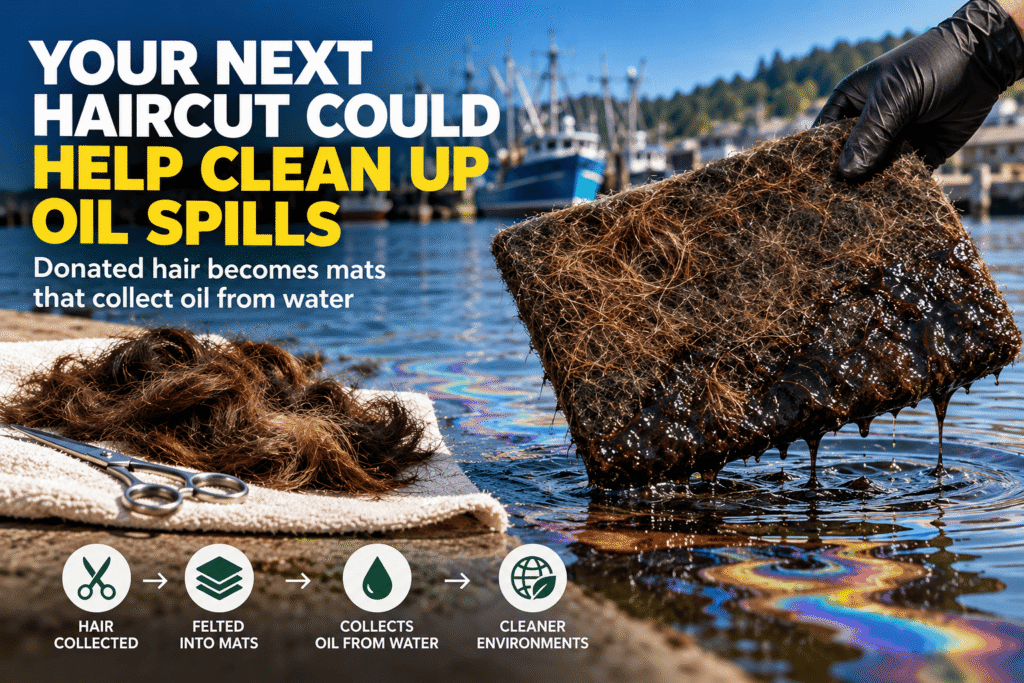
Most hair swept from the floor after a haircut has little obvious value.
But that same material has a property that becomes useful when petroleum reaches water.
Oil readily coats hair.
The nonprofit Matter of Trust collects hair clippings, animal fur, wool and fleece and turns these waste fibres into felted mats and booms that can collect petroleum from spills, storm drains and other contaminated areas.
It sounds almost too simple.
Scientific research, however, shows that human hair really can function as an oil sorbent.
And the idea provides an unusual example of a waste material receiving a useful second life.
Hair does not behave exactly like a sponge
When people describe these mats, it is common to say that hair absorbs oil.
The more accurate term is adsorption.
Instead of simply swelling like a sponge and storing liquid internally, much of the oil attaches to the surface of the hair fibres.
Matter of Trust describes the effect as oil coating the large surface area created by thousands of individual strands.
This becomes easier to understand by thinking about ordinary hair.
Natural oils accumulate on hair between washes.
That same interaction with oily substances can be useful when large amounts of hair are collected and formed into a material designed specifically for pollution control.
What does the scientific research say?
A 2015 study published in the Journal of Environmental Chemical Engineering tested human hair with vegetable oil, crude oil and diesel.
The researchers found that the hair samples collected approximately three to nine times their own weight in oil, depending on the hair and oil type tested.
The study also found that the recovered hair could be reused in laboratory testing without major deterioration in sorption capacity.
That does not mean every hair mat used in a real spill will perform exactly the same way.
Real environments contain water, sediment, organic matter and many other substances that are absent from controlled laboratory experiments.
But the research confirms the underlying idea.
Hair has measurable oil collecting capacity.
More recent research reached a similar conclusion
A 2023 study examined human hair for removing diesel from synthetic seawater.
The researchers reported a maximum adsorption capacity of approximately 4.95 grams of oil per gram of hair under their experimental conditions.
They tested both batch systems and columns filled with hair and found high removal performance under selected experimental conditions.
Again, these results should not be interpreted as a guarantee that every kilogram of donated hair will remove exactly the same amount of petroleum during a real spill.
Oil type, temperature, water conditions, mat construction and contact time can all change performance.
The important finding is that discarded human hair is not merely capable of touching oil.
It can function as a genuine sorbent material.
Hair is not automatically better than synthetic sorbents
This is where the research becomes more interesting.
Natural does not automatically mean better in every engineering measurement.
A 2018 study published in the Journal of Environmental Management compared human hair with other natural materials and conventional polypropylene used in oil spill booms.
Hair collected more crude oil per gram than the other natural materials evaluated.
However, polypropylene had the highest overall oil adsorbency ratio, followed by hair.
The study also identified an important weakness.
Hair was less naturally buoyant than some alternatives.
That matters because an oil collection material used on water needs to remain near the surface where much of the floating petroleum is located.
Researchers suggested that hair can benefit from flotation support or suitable boom construction when used in aquatic environments.
So the argument for hair mats is not that they outperform every synthetic sorbent in every situation.
Their advantage comes from combining useful oil collection properties with a material that already exists as a waste stream.
How hair clippings become mats
Matter of Trust operates what it calls its Hair Matters Program.
Hair from salons, fur from pet groomers and fibres such as wool and fleece can be collected instead of being discarded.
Long fibres can be used in scrim structures, while other fibres are processed into felted mats.
The organisation also produces boom shaped products that can surround contaminated areas or drains.
The basic cycle looks like this:
Haircut
↓
Hair collected instead of discarded
↓
Fibres sorted and felted
↓
Mats or booms produced
↓
Material placed where oil needs to be collected
↓
Oil coated sorbent removed for proper handling
A waste product from one activity becomes an input for another.
That is circular economy thinking in one of its simplest forms.
The idea began with an oily head of hair
The history of the project goes back several decades.
Matter of Trust credits Alabama hairdresser Phil McCrory with developing the idea after watching television coverage of the Exxon Valdez oil spill.
Seeing wildlife coated with petroleum reportedly made him think about something familiar from his work as a hairdresser.
Hair collects oil.
Matter of Trust founder Lisa Gautier began working with McCrory in 1999, and the organisation later expanded the concept into a programme collecting waste fibres for pollution control.
What started as an observation in a salon eventually became a system linking salons, pet groomers, volunteers, researchers and pollution management projects.
The mats are not only for major oil spills
When people hear the words oil spill, they often imagine a tanker accident or offshore platform disaster.
But petroleum pollution also reaches waterways through much smaller sources.
Vehicles leak motor oil.
Machinery releases lubricants.
Fuel and oil accumulate on roads and industrial surfaces.
Rain can carry some of this contamination toward storm drains.
Matter of Trust says its mats are used in and around storm drains, at public works sites, near vehicle fleets, under machinery and in other locations where petroleum needs to be captured before it spreads further.
This may ultimately be one of the technology’s most practical roles.
Instead of waiting for a major environmental emergency, sorbent materials can be positioned where smaller pollution events repeatedly occur.
A storm drain can be the last chance to catch the oil
Stormwater systems are designed primarily to move rainwater away from streets.
That means whatever is sitting on the road can sometimes travel with it.
Putting an oil collecting material near a drain creates an interception point between the polluted surface and the receiving environment.
Matter of Trust reports using its fibre products in storm drain cages and around drain openings to capture oil associated with vehicles and urban runoff.
This turns the concept from emergency cleanup into pollution prevention.
That distinction matters.
Cleaning petroleum after it has spread across a river or coastline is much more difficult than intercepting smaller quantities before they reach those environments.
Why use hair when polypropylene already works?
Synthetic polypropylene is widely used for oil sorbent pads and booms for a reason.
It is lightweight, effective and can be designed specifically for spill response.
The circular economy question is slightly different.
Do we always need to manufacture a new petroleum based sorbent when large quantities of natural fibre waste already exist?
Hair is continuously generated.
People need haircuts regardless of whether there is a demand for oil sorbents.
Pet groomers also generate fur.
Farms generate wool and fleece that may not always have a high value application.
Matter of Trust’s approach attempts to redirect part of these existing fibre streams into a useful product.
It follows the same broader principle seen in other material innovations.
In one example, naturally fallen palm material can be pressed into disposable tableware instead of relying entirely on conventional plastic products. Read how the process works in our article on fallen palm leaves becoming plates. Fallen palm leaves turned into plates
Another approach uses fungal mycelium to bind plant material into protective packaging. You can explore the research behind mushroom packaging as an alternative to plastic foam here. How mushroom packaging works
Different materials.
The same question.
Can something normally treated as waste become a useful resource instead?
There are important limitations
Hair mats should not be presented as a perfect answer to oil pollution.
One problem is buoyancy.
The comparative 2018 study found that hair had lower natural buoyancy than some competing materials.
Matter of Trust also advises that hair based sorbents used in water need to be retrieved rather than left indefinitely because sediment, seaweed and other material can eventually weigh them down.
Contaminated mats also create another issue.
Once a mat collects petroleum, the pollution has not disappeared.
It has simply moved from the water onto the sorbent.
The used material therefore needs appropriate recovery, handling and disposal according to the contaminant and local waste requirements.
This is true for synthetic oil sorbents as well.
Oil cleanup is ultimately a process of capturing contamination so it can be controlled and removed.
Reuse is possible, but not always practical
Laboratory research has demonstrated that hair can retain considerable sorption ability after oil recovery and reuse.
Real spill conditions are more complicated.
A mat used outdoors may also collect sand, dirt, vegetation and other contaminants.
Matter of Trust says mats can physically be wrung out, but the organisation generally considers fresh fibre preferable once a heavily contaminated mat becomes difficult to handle.
This shows why laboratory capacity and real world usability should not be treated as exactly the same thing.
A material may technically remain capable of collecting oil while still becoming impractical to reuse in the field.
Local production matters
There is another environmental consideration that is easy to overlook.
Shipping boxes of low density hair across long distances requires transportation.
If waste hair is transported hundreds or thousands of kilometres to a processing facility and then the finished mats travel another long distance to their final user, some of the environmental benefit can be reduced.
Matter of Trust acknowledges this issue and has been developing a network of local partners and small scale production sites so waste fibres can be processed closer to where they are generated and needed.
This is an important circular economy principle.
Using waste is good.
Using local waste for a local need can be even better.
Hair is part of a much bigger waste materials question
The most interesting part of this project may not be hair itself.
It is the idea behind it.
Many materials are classified as waste simply because their original owner no longer has a use for them.
A haircut creates hair clippings.
A wind farm eventually produces retired turbine blades.
Agriculture produces plant residues.
Food systems generate organic byproducts.
Industrial processes generate heat.
Each one creates the possibility of asking a different question:
Before we manufacture something new, is there an existing material that could already perform part of the job?
That question is appearing across sustainability research.
The same thinking can be seen in energy systems.
Finland is using abundant solid material for thermal energy storage in what has become known as a sand battery. How Finland’s sand battery stores energy
In California, engineers are using the space above irrigation canals to produce solar electricity while also reducing water evaporation. Why California is putting solar panels over canals
Researchers at MIT have approached water scarcity from another direction by developing materials capable of harvesting moisture from very dry air. How the MIT water harvesting panel works
None of these technologies solves an environmental problem on its own.
What they demonstrate is a shift toward making better use of materials, energy and infrastructure that are already available.
A haircut is a very small waste stream
One haircut produces only a small pile of fibres.
That is what makes this idea easy to dismiss.
But circular systems rarely depend on one individual item being valuable.
Their value comes from aggregation.
One salon generates hair every day.
Thousands of salons generate considerably more.
Pet groomers and farms add other natural fibres.
Once those streams are collected systematically, something normally treated as rubbish becomes a manufacturing feedstock.
The result is not a miracle solution to oil pollution.
It is something more realistic.
A readily available waste material can perform a useful environmental function when it is collected, processed and deployed in the right way.
Your next haircut will not clean an ocean by itself.
But the fibres on the salon floor do not necessarily have to become waste either.
Research and external sources
Matter of Trust Hair Matters Program
Matter of Trust explains how donated hair, fur, wool and fleece are processed into mats and other fibre products used for petroleum cleanup and pollution prevention. Explore the Hair Matters Program
Matter of Trust research and applications
The organisation documents uses including storm drains, machinery, oil collection areas and spill response. See how the hair mats are used
Journal of Environmental Chemical Engineering
The 2015 study measured the oil sorption behaviour of human hair with crude oil, diesel and vegetable oil and found capacities ranging from approximately three to nine times the weight of the hair under the tested conditions. Read the human hair oil sorption study
Journal of Environmental Management
The 2018 study compared hair with natural byproducts and synthetic polypropylene sorbents and highlighted both hair’s strong crude oil adsorption and its lower buoyancy. Read the comparative sorbent study
Chemometrics and Intelligent Laboratory Systems
A 2023 study tested human hair for diesel removal from synthetic seawater and reported a maximum experimental adsorption capacity of approximately 4.95 grams per gram. Read the 2023 human hair study