Last Updated on September 21, 2026 by Gavi
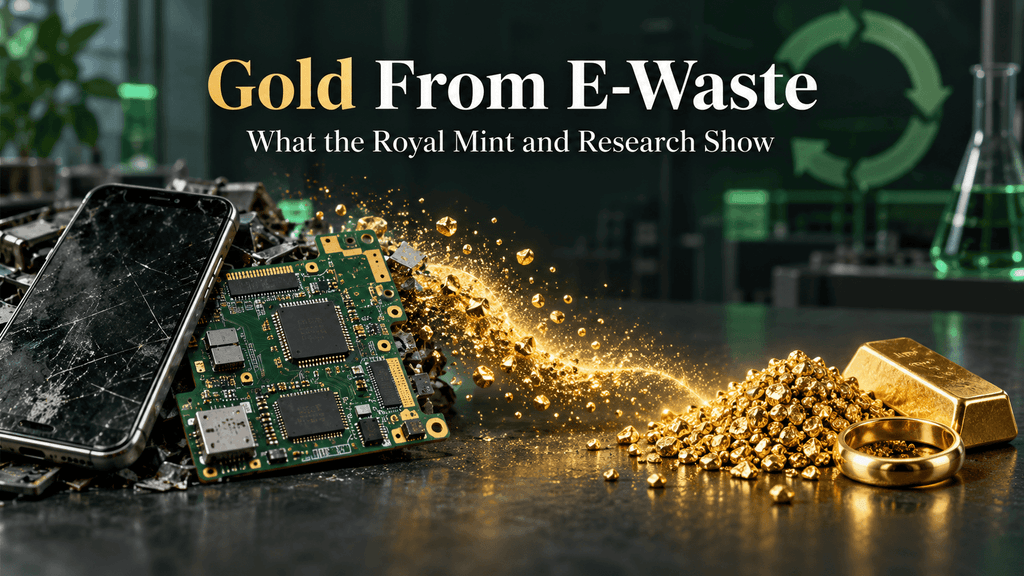
That old phone sitting forgotten in a drawer may contain something far more valuable than its resale price suggests.
Inside its circuit boards are copper, silver and tiny quantities of gold.
Individually, those amounts are small. But when thousands of discarded phones, laptops and other electronic devices are brought together, e-waste begins to look less like rubbish and more like an urban mine.
The Royal Mint in the UK is now putting that idea into practice.
At its facility in South Wales, gold is being recovered from discarded electronic circuit boards and returned to use in new products.
But an important question remains:
How much gold can actually be recovered from one tonne of electronic circuit boards?
Recent peer-reviewed research provides some useful numbers — and also shows why the answer is more complicated than a single figure.
The Royal Mint is extracting gold from electronic waste
The Royal Mint opened its precious-metals recovery facility in South Wales in August 2024.
The 3,700-square-metre facility uses patented chemistry developed by Canadian clean-technology company Excir to recover precious metals from printed circuit boards found in discarded electronics such as phones, laptops and televisions.
According to the Royal Mint, Excir’s chemistry can recover more than 99% of the gold contained in the material being treated.
One particularly interesting feature is temperature.
Instead of depending on conventional high-temperature smelting to access the gold, the Excir chemistry operates at room temperature.
The Royal Mint says the facility has capacity to process as much as 4,000 tonnes of printed circuit boards each year.
More details on the facility are available in the Royal Mint’s official announcement: New Factory Extracting Gold from E-Waste Unveiled by The Royal Mint.
That takes the idea well beyond a small laboratory experiment.
The recovered gold is already being used
The gold does not simply end up stored in a vault.
The Royal Mint is using recovered e-waste gold in its 886 by The Royal Mint jewellery range.
Its recovered-materials programme also identifies other materials from printed circuit boards that can remain in circulation, including silver, palladium, copper, iron and aluminium.
This is one of the central ideas behind a circular economy:
a product reaching the end of its first life does not necessarily mean the materials inside it have reached the end of theirs.
So how much gold is actually inside old circuit boards?
There is no universal answer.
A tonne of mixed electronic waste is not the same thing as a tonne of high-grade mobile-phone circuit boards.
Gold concentration varies according to:
- device type;
- circuit-board design;
- age of the electronics;
- manufacturer;
- component density; and
- how the material has been sorted before processing.
That is why claims about “gold per tonne of e-waste” need context.
A useful example comes from a peer-reviewed study published in Sustainable Materials and Technologies.
Researchers investigated the recovery of metals from waste printed circuit boards from mobile phones.
The peer-reviewed research measured approximately:
439 grams of gold per tonne of circuit boards
But this figure describes the gold contained in the feed material.
It does not mean that all 439 grams were recovered.
How much gold did the researchers actually recover?
The hydrometallurgical process tested in the study achieved an overall gold recovery of 78.9%.
From one tonne of the waste mobile-phone circuit boards, the process recovered approximately:
346 grams of gold
That distinction is important.
Gold present in the studied circuit boards: approximately 439 g/t
Gold recovered by the tested process: approximately 346 g/t
Overall gold recovery: 78.9%
The researchers also recovered substantial quantities of other metals, including copper and tin.
This shows why electronic-waste recycling should not be viewed only as “gold recovery.”
A circuit board contains a mixture of materials, and the economics can depend on recovering several of them efficiently.
Are those Royal Mint recovery figures?
No.
This is an important distinction.
The 439 g/t and 346 g/t figures come from the separate peer-reviewed research study involving waste mobile-phone printed circuit boards.
They are not operating figures released by the Royal Mint.
The Royal Mint reports that Excir’s technology can recover more than 99% of the gold contained in the material it processes, but it has not publicly stated that every tonne of circuit boards entering its facility contains 439 grams of gold.
Those two numbers describe different things:
Gold concentration tells us how much gold is initially present.
Recovery efficiency tells us what percentage of that gold a particular process can successfully retrieve.
A process could have very high recovery efficiency while processing relatively low-grade material — or lower recovery efficiency while treating material with a much higher initial gold concentration.
Does recovering gold from circuit boards require acids and electrolysis?
The research process provides an interesting example.
It was a multi-stage hydrometallurgical system rather than a simple “put the circuit boards in acid and collect the gold” process.
The researchers first targeted base metals.
Sulphuric acid and hydrogen peroxide were used during the base-metal leaching stages.
The precious-metal stage used a different chemical system involving thiourea and ferric sulphate.
Gold and silver were subsequently recovered through electrodeposition and refining.
The overall process recovered:
- 97.3% of copper;
- 91.6% of tin;
- 78.9% of gold; and
- 67.7% of silver.
Full methodology and results are available in the research paper.
The Royal Mint process should not be assumed to use exactly the same chemistry.
Excir’s commercial formulation is patented, and the Royal Mint describes the technology’s performance without publicly revealing every detail of the process.
What about the cost of recovering the gold?
This is where public information becomes more limited.
The research paper includes a techno-economic analysis based on a hypothetical plant handling 500 tonnes of waste printed circuit boards per year.
Its analysis concluded that gold was the main factor influencing project revenue and that economic performance was particularly sensitive to the gold price, recovered-metal purity and the cost of obtaining waste circuit boards.
A recycling plant does not become profitable simply because gold exists inside the waste.
It also needs:
- enough valuable material in the incoming feedstock;
- efficient collection and sorting;
- high recovery performance;
- manageable chemical and energy consumption;
- effective wastewater and residue management; and
- reliable markets for recovered materials.
The Royal Mint has not publicly provided a comparable detailed cost-per-tonne figure for its Excir-based commercial facility.
So assigning the economics of the research process directly to the Royal Mint facility would be misleading.
The scale of the e-waste problem is much larger than gold
Why does any of this matter?
Because electronic waste is growing quickly.
According to the Global E-waste Monitor 2024, the world generated approximately 62 million tonnes of e-waste in 2022.
Only 22.3% was documented as formally collected and recycled.
Global e-waste generation is projected to reach approximately 82 million tonnes by 2030.
The report, produced by the International Telecommunication Union and UNITAR, also highlights the enormous economic value locked inside discarded electronics.
Recovering gold attracts attention because of its value.
But the bigger circular-economy opportunity is recovering as much useful material as possible while preventing hazardous components from being poorly managed.
This is part of a much wider circular-economy shift
Electronic waste is only one example of a broader question:
Can materials normally treated as waste become useful inputs for something else?
We are already seeing that idea appear in very different sectors.
Discarded human hair, for example, can be processed into sorbent mats capable of collecting petroleum.
Read: Hair Mats for Oil Spills: How Hair Clippings Help Clean Up Oil
Retired wind-turbine blades present another difficult waste stream because their composite construction makes conventional recycling challenging.
One project in Ireland has taken a different approach by using decommissioned turbine blades as structural components in a pedestrian bridge.
Read: Wind Turbine Blade Bridge in Ireland: What the Research Shows
And circular thinking is not limited to physical waste.
Energy that would otherwise be difficult to use immediately can also be stored for later.
In Finland, crushed material is being used as a thermal storage medium in a large-scale “sand battery.”
Read: Finland Sand Battery: How Crushed Stone Stores Renewable Energy
Hair.
Wind-turbine blades.
Crushed stone.
Electronic circuit boards.
These examples involve completely different materials and technologies, but they share one idea:
look at an existing resource before automatically demanding a new one.
Urban mining could become increasingly important
Traditional mining begins with geological deposits.
Urban mining begins with products that society has already manufactured.
Every phone, computer and electronic device required metals to be extracted, refined, processed and manufactured before it reached the consumer.
When that product reaches the end of its useful life, disposing of those materials means losing part of that earlier investment.
Recovering them will not eliminate the need for primary mining.
Collection losses, technical limitations, material degradation and growing demand make that unrealistic.
But better recovery can reduce the amount of valuable material that disappears from the economic system after only one product life.
The real lesson from 439 grams of gold
The headline number is interesting:
439 grams of gold per tonne of mobile-phone circuit boards in the material examined by researchers.
But the more useful number may be the 346 grams actually recovered.
It reminds us that having valuable material inside a waste stream and successfully recovering it are two different challenges.
Collection matters.
Sorting matters.
Feed quality matters.
Process efficiency matters.
Environmental controls matter.
And economics matter.
The Royal Mint project shows what happens when those questions begin moving from laboratory research toward industrial-scale operation.
An old phone may no longer make calls.
But the materials inside it may still have another job.
Research and external sources
Royal Mint — Gold Recovery Technology
https://www.royalmint.com/gold-recovery/our-technology/
Royal Mint — New Factory Extracting Gold from E-Waste
https://www.royalmint.com/aboutus/press-centre/new-factory-extracting-gold-from-e-waste-unveiled-by-the-royal-mint/
Royal Mint — Recovered Materials
https://www.royalmint.com/gold-recovery/e-waste-recycling/recovered-materials/
Peer-reviewed research — Sustainable Materials and Technologies
https://doi.org/10.1016/j.susmat.2025.e01812
Global E-waste Monitor 2024 — ITU
https://www.itu.int/en/ITU-D/Environment/Pages/Publications/The-Global-E-waste-Monitor-2024.aspx
UNITAR — Global E-waste Monitor
https://unitar.org/about/news-stories/press/global-e-waste-monitor-2024-electronic-waste-rising-five-times-faster-documented-e-waste-recycling